

CEREBRIS project kicks off to revolutionise neurological care with next-generation AI technologies
University of Bath leads a new European collaboration to improve clinical decision-making, patient outcomes, and access to advanced neuroimaging
Neurological diseases are among the most significant health challenges faced in Europe and globally, placing an unprecedented burden on European healthcare systems and societies. In Europe alone, neurological conditions — including stroke, Alzheimer’s disease, Parkinson’s disease and multiple sclerosis — affect more than 165 million people, with an estimated annual cost exceeding €800 billion (European Brain Council). Stroke, a primary focus of the CEREBRIS project, remains one of the most devastating conditions, accounting for over 1.1 million deaths annually in Europe and leaving millions more with long-term disability (WHO Europe).
Responding to this urgent need for faster, more precise, and more personalised approaches to care, CEREBRIS, a new European collaborative project led by the University of Bath and backed by the European Innovation Council (EIC) Pathfinder funding scheme, officially kicks off today with the aim of advancing AI-powered stroke care and neurological disease management. The project will combine multimodal data integration, advanced neuroimaging, and multi-agentic artificial intelligence (AI) to develop tools that support clinicians, improve access to actionable insights, and contribute to more personalised care for patients affected by stroke and neurological conditions.
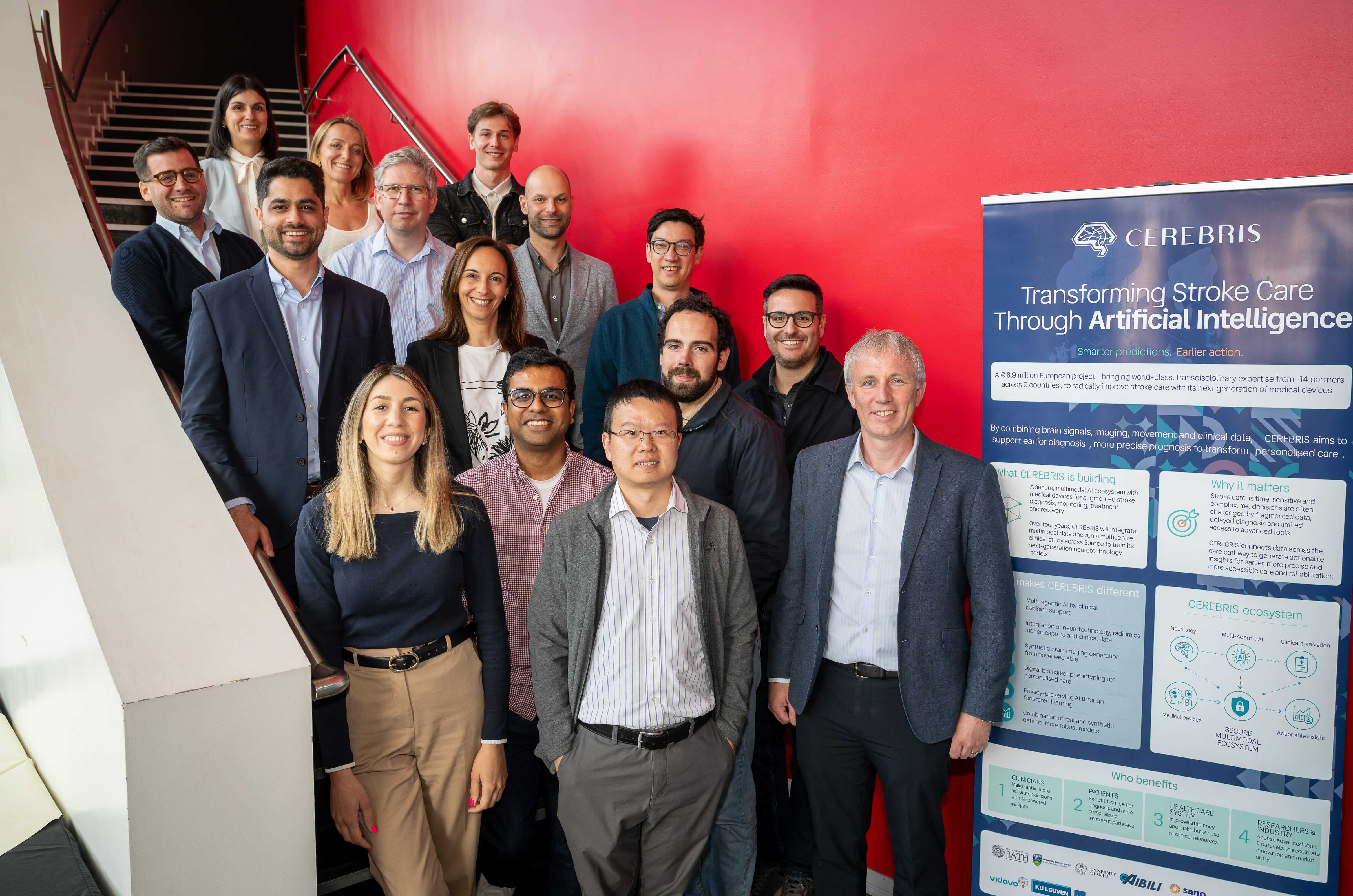
CEREBRIS brings together a multidisciplinary consortium of 14 partners across Europe, including experts in clinical research, healthcare, AI, neuroimaging, digital health, social sciences, and patient-centred innovation. Through this collaboration, the project’s long-term vision aims to bridge the gap between cutting-edge AI research and real-world clinical and patient needs.
“I am proud to have my next venture backed by the European Innovation Council. As a medical doctor and entrepreneur, this is an outstanding milestone. This is where ambition meets the right people, at the right time, for the right mission. Our consortium is among the first challenge-based projects funded at this level. This support will accelerate our work in next-generation diagnostics and allow us raining and refining our AI models, addressing critical unmet needs in neurological disease. Our team brings together the very best of Europe in the realm of scientific, clinical and engineering expertise - driven to deliver on our goal. Our single, united purpose is to develop and translate medical devices that have the potential to transform care for stroke survivors in Europe and beyond”, said Dr Jibraan Esoof, Project Coordinator and Research Physician, University of Bath.

Over the coming years, CEREBRIS will focus on developing a proof-of-concept system validated in clinical environments. At the heart of CEREBRIS is a suite of interconnected AI agents designed to work seamlessly across the patient care pathway and capable of collecting and assessing real-time neural feedback, objectively evaluating motor functions, integrating multimodal data sources and generating synthetic neuroimaging data from wearable signals. A federated learning network and decentralised AI reasoning system will connect clinical sites and securely aggregate data preserving patient privacy while enabling researchers and developers to safely validate AI solutions.
“Being part of the CEREBRIS journey alongside such a strong European consortium reflects the value of bringing together cutting-edge science, multidisciplinary collaboration, and a shared sense of purpose to address some of Europe’s most pressing healthcare challenges. At a time when funding is becoming increasingly competitive and market-driven, this initiative stands out as a testament to the importance of visionary research. Wise Angle leads the activities of project management, dissemination and communication and remains committed to ensuring that the project's outcomes translate into meaningful, real-world impact for patients, clinicians, and healthcare systems”, said Valentina Tageo, Founder and Director Wise Angle.
The CEREBRIS project kicks off today, Tuesday 12 May 2026, with an initial consortium meeting focused on setting the foundations for the project’s research, development, validation, and communication activities. The meeting marks the start of a collaborative effort to turn CEREBRIS’ scientific and technological ambitions into practical tools for future stroke care and neurological disease management with the ultimate goal to automate traditionally time-consuming and subjective clinical assessments, significantly reducing the burden on healthcare professionals while improving precision and consistency.
To stay up to date on the latest CEREBRIS news, follow the project on LinkedIn.