
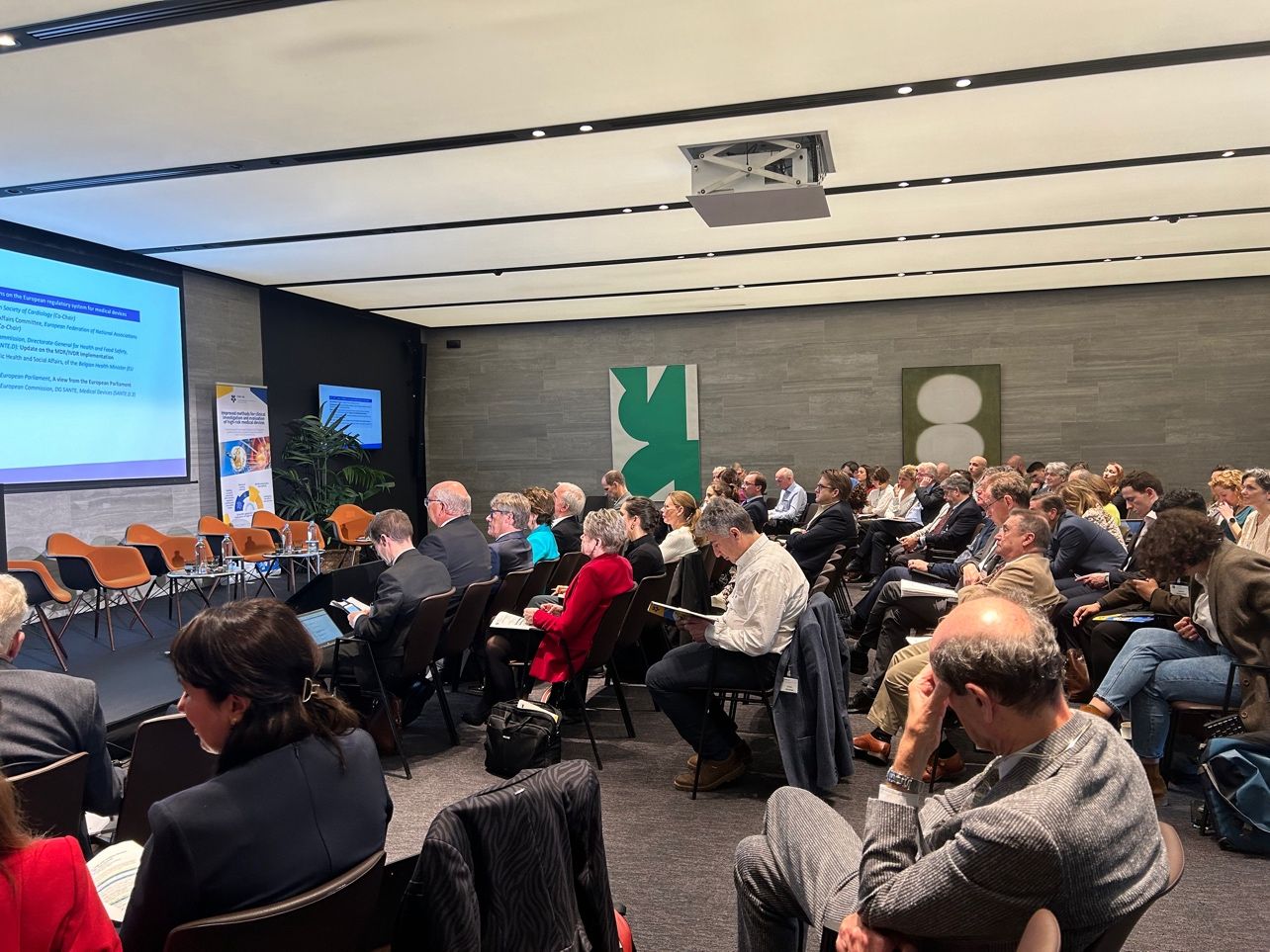
On 15 March 2024, the CORE-MD Consortium organised its Final Conference in Brussels, bringing together consortium partners, European institutions, regulators, clinicians, researchers, industry representatives and patient advocates to discuss the ongoing implementation of the European Medical Device Regulation (MDR).
The event marked the conclusion of three years of intensive collaboration aimed at supporting the scientific and regulatory framework surrounding high-risk medical devices in Europe. Throughout the conference, speakers reflected on both the progress achieved and the challenges that still need to be addressed to ensure innovation, patient safety and regulatory efficiency across the European healthcare ecosystem.
Opening the conference, Alan Fraser reviewed the origins and objectives of the Medical Device Regulation, highlighting the need to strengthen safety standards and improve the quality and transparency of clinical evidence supporting medical devices placed on the European market. He also presented the broader objectives of the CORE-MD initiative and its expected long-term contribution to the implementation of the MDR.
The first session focused on the European regulatory system for medical devices and featured perspectives from policymakers and institutional representatives. Rainer Becker provided an update on the implementation of the MDR, stressing that the regulation was designed to increase patient safety and reinforce evidence requirements for manufacturers. Speaking on behalf of the Belgian Presidency of the European Union, Paul Balecher underlined the importance of strengthening cooperation on medical devices to encourage innovation while ensuring high standards of safety and quality.
A major part of the conference was dedicated to presenting the scientific outcomes generated by the CORE-MD project. During the second session, consortium experts showcased research findings developed across multiple work packages and thematic areas.
Robert Byrne presented the work carried out on the quality and transparency of evidence for implantable cardiovascular medical devices, including dedicated studies exploring representation related to age, sex and ethnicity in prospective clinical investigations of high-risk devices.
Research on the use of real-world and registry data for post-market surveillance was presented by Perla Marang-van de Mheen. Her presentation highlighted the complexity and heterogeneity of real-world data sources, including registries, electronic health records and safety notices. The research led to the development of a decision framework intended to support regulators and decision-makers in assessing the reliability and relevance of medical device performance data.
Artificial Intelligence also emerged as a central theme during the conference. Frank Rademakers introduced recommendations on the clinical evaluation of AI-based medical devices. Using a risk-based methodology, the framework proposes a scoring system based on technical performance, clinical performance and valid clinical association to help regulators define appropriate requirements during both pre-market and post-market phases.
The importance of pedriatric medical device research was addressed by Berthold Koletzko, who presented the results of a scoping review on clinical investigations involving medical devices for children. The work also contributed to recommendations on the evaluation of high-risk paediatric devices developed following the CORE-MD Munich Workshop.
The third session shifted the discussion towards science-based regulatory policy and the future of evidence-based regulation in Europe. Returning to the stage, Prof. Alan Fraser summarised several of the consortium’s key recommendations, including educational roadmaps, frameworks supporting patient involvement in Patient-Reported Outcome Measures (PROMs), ethical guidelines and risk-based approaches for AI clinical evaluation.
Representatives from European agencies and organisations also contributed important perspectives. Miguel Antunes discussed the role of the European Medicines Agency in advancing regulatory science and supporting collaborative research initiatives. Meanwhile, Penilla Gunther emphasised the risks associated with failed implementation processes and their direct consequences on patient safety.
From the notified bodies perspective, Sabina Hoekstra explained how notified bodies have had to significantly adapt their structures and expertise to comply with the stricter expectations introduced by the MDR, particularly regarding safety, clinical evidence and regulatory oversight.
The conference concluded with a final panel discussion on international regulatory convergence and future priorities for medical device governance. Speakers highlighted the importance of global collaboration, harmonisation and continued dialogue between regulators, industry and healthcare stakeholders.
Among them, Niall McAleenan discussed the work of the International Medical Device Regulators Forum (IMDRF) and the benefits of stronger regulatory convergence. Flora Giorgio presented the European Commission’s ongoing efforts to reinforce the regulatory framework, while Petra Zoellner outlined some of the major operational challenges faced by manufacturers under the MDR, including increased bureaucracy, rising costs and longer approval procedures.
Overall, the CORE-MD Final Conference offered an important opportunity to reflect on the evolution of the European regulatory landscape for medical devices and to underline the need for continued scientific collaboration, patient-centred approaches and evidence-based policymaking in the years ahead.
Download the final booked here